

How Do Artists Create Different Gradations Of Black When They Draw With Charcoal?
- Home
- Cartoon Tutorials
- Black and White Charcoal Drawing
How to Create a
Blended Blackness and White
Charcoal Drawing
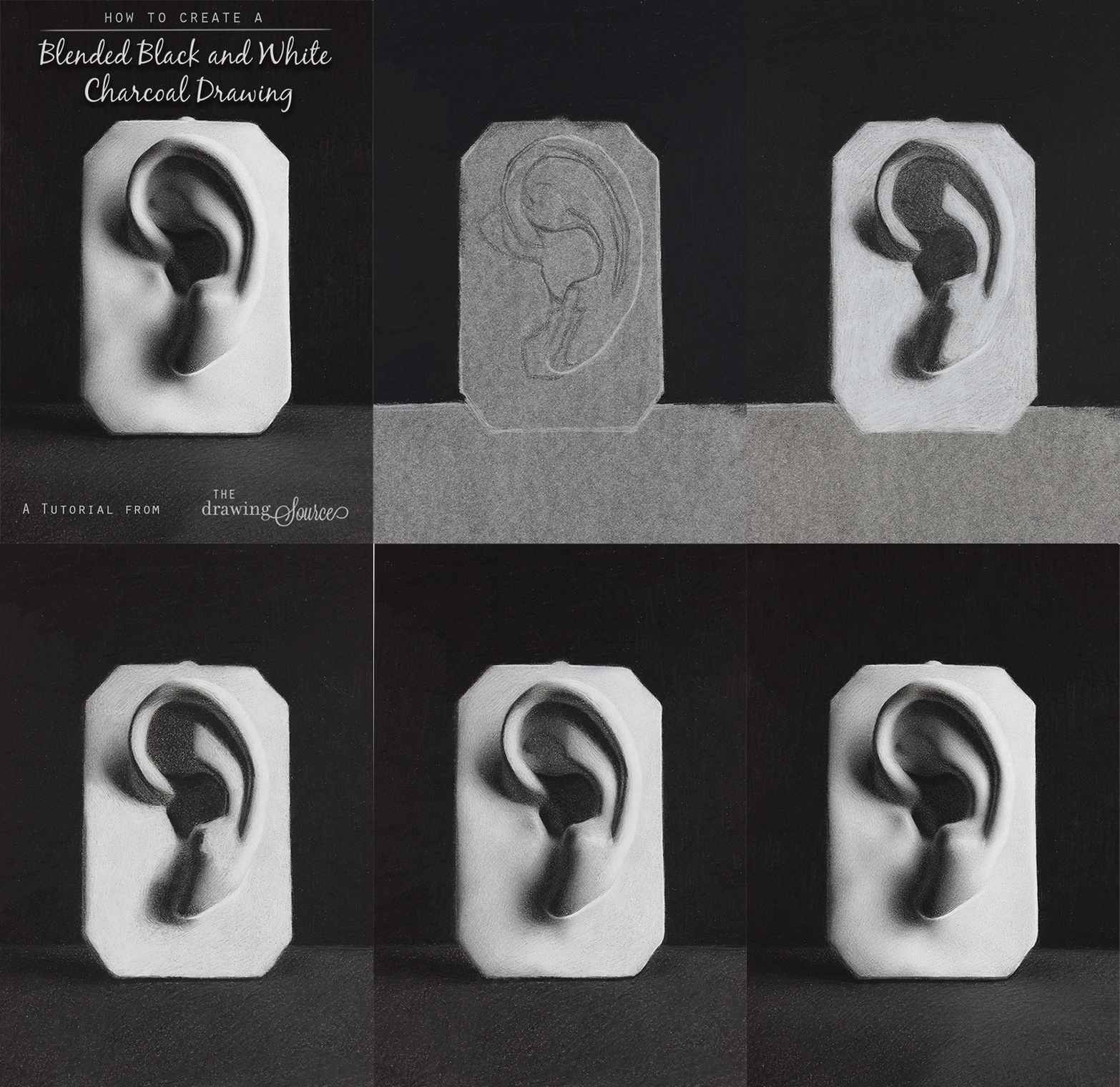
Introducing ane of my favorite techniques: the blended black and white charcoal drawing technique!
Pencils usually known as 'white charcoal' have a slightly bluish color temperature, and when layered over summit of regular charcoal, they create a cute, silvery surface quality. Check out my folio on 3 Ways to Use White Charcoal Pencils for ii other methods of using these fabulous drawing tools, and for a side-by-side comparison of a drawing that contains white charcoal vs. one that does not.
As you volition see in the Materials List below, I will be drawing on a sheet of homemade toned paper, which y'all tin learn to make here.
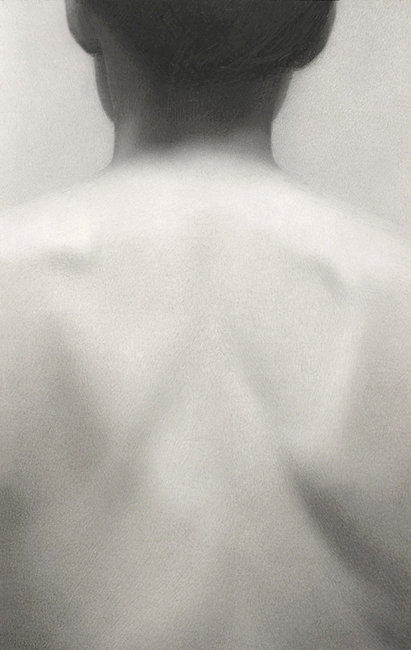 Longer, finished figure drawing using black and white charcoal
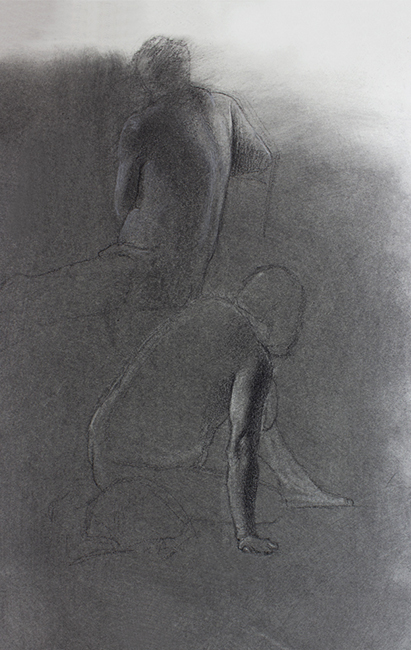 Quick sketch effigy drawing using black and white charcoal
I enjoy using this black and white charcoal drawing technique for both longer, finished drawings, such as the i above on the left, and for quicker sketches. Above on the right are a few fifteen-minute figure studies.
Because the mid-tones are established by the toned newspaper, using this method we are complimentary to focus on adding low-cal and dark values, making this an efficient technique for quicker drawings.
F R Due east E D O W N 50 O A D
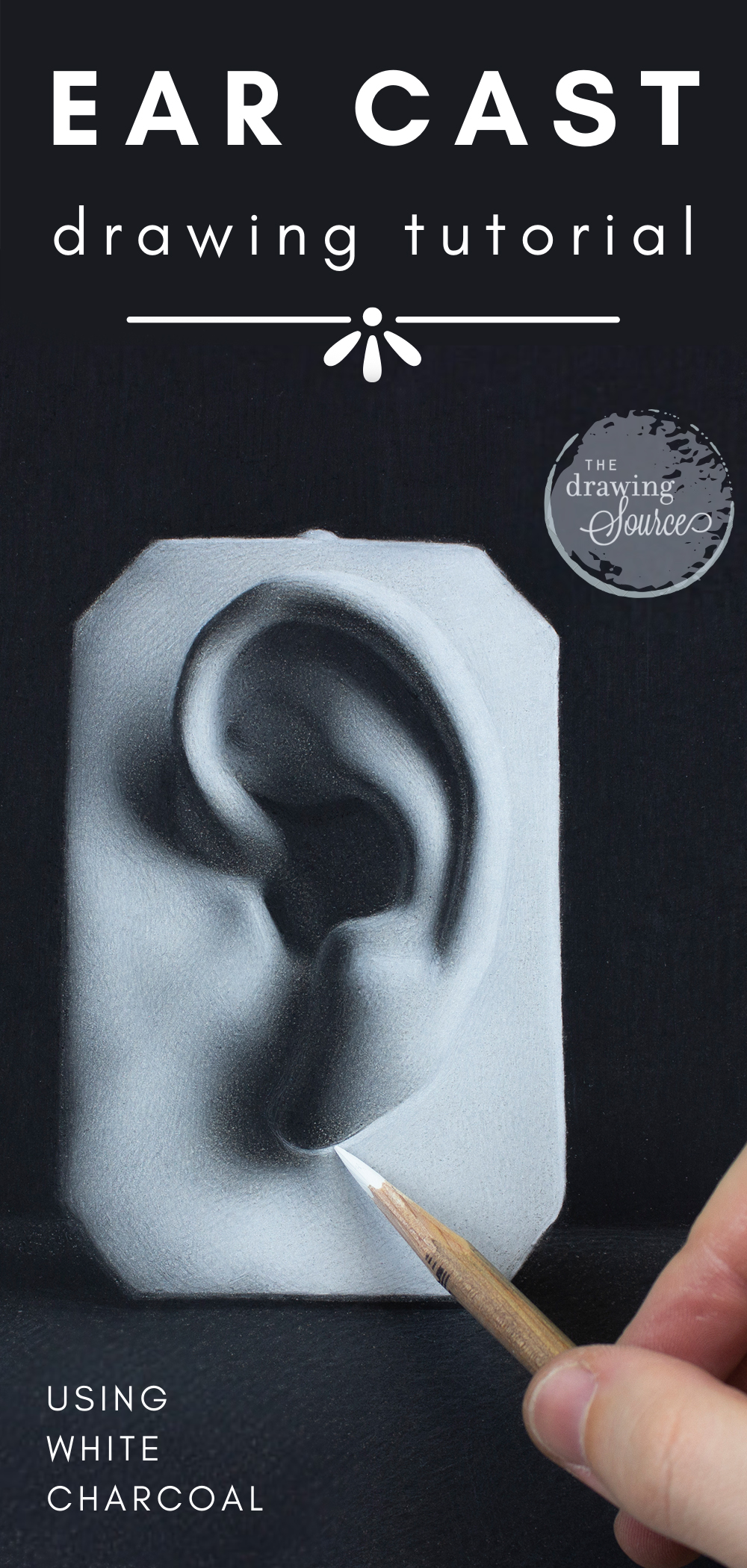
At the end of this article, download a photo reference of the ear cast I'm drawing from, an infographic of this tutorial, and create a black and white charcoal drawing along with me!
Creating a Black and White Charcoal Drawing:
Materials Used in This Tutorial
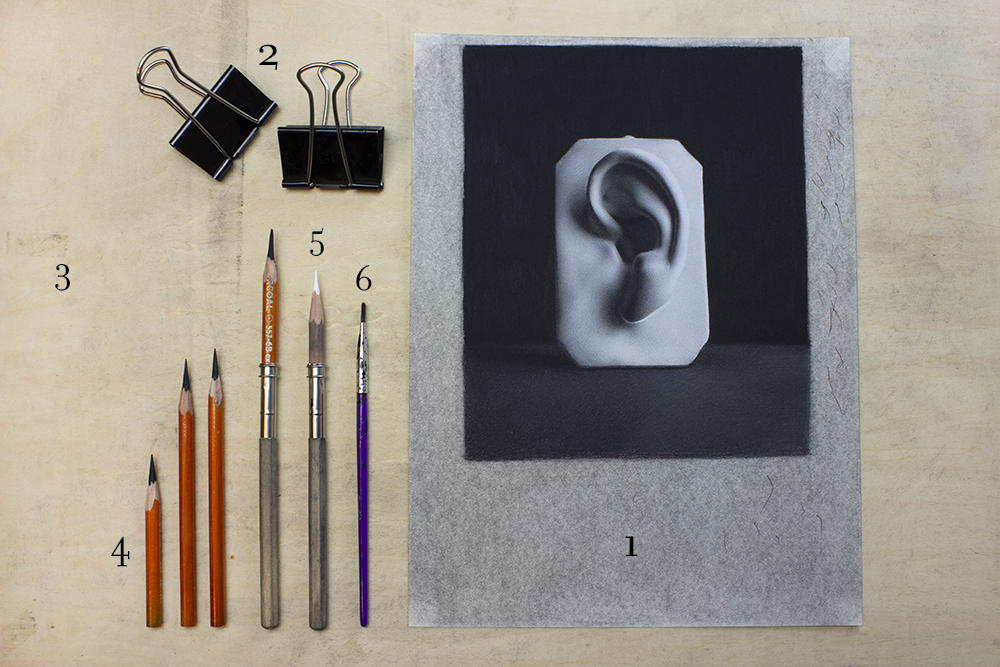
- Homemade Toned Paper: I am using a homemade toned paper in this drawing (I toned a canvass of Strathmore 400 Cartoon Paper). Check out this tutorial to larn how to make your own!
- Bulldog Clips: A convenient way to attach a drawing to a cartoon board, and preferable to using record, which often leaves a residue or rips your paper!
- Drawing Board: This is a lightweight drawing lath made past Helix.
- General's Charcoal Pencils: HB, 2B, 4B and 6B.
- General'due south White Charcoal Pencil
- Paintbrush: Inexpensive paintbrushes such as this one are swell for blending charcoal.
- Mahl stick: Sorry, forgot to include it in the photo to a higher place! Equally you will see later in the tutorial, a Mahl stick allows me to comfortably reach all areas of my drawing without smudging information technology. I demonstrate this in my How to Hold and Control Your Drawing Pencil video.
Detect that a common drawing tool is not on this textile list ...
In that location is no kneaded eraser! This 'blended blackness and white charcoal cartoon' technique is quite unique in that information technology involves no erasing.
Instead, it is an entirely additive process. Lighter values are added using white charcoal, and darker values are added using regular charcoal.
How to Create a Blended Black and White Charcoal Cartoon
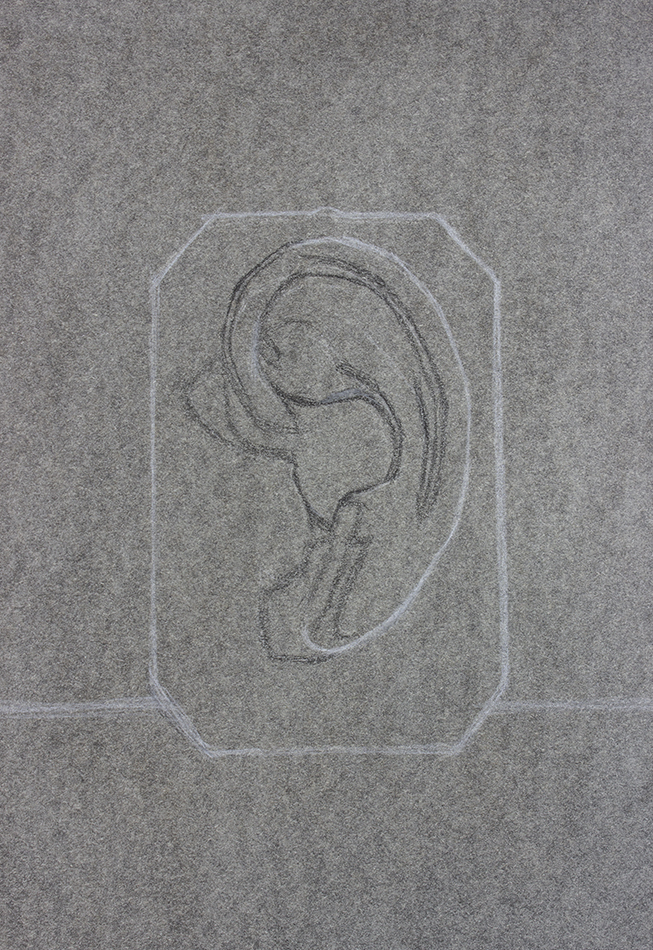
Because this tutorial focuses on the shading stage of drawing, using black and white charcoal, I am going to begin this demonstration with the finished block-in.
I drew my cake-in with both blackness and white charcoal, though this is not a requirement. I chose to do and so because the line of the ear on the far right is a very light value, as is the background behind information technology. I didn't desire to draw a dark line that would be difficult to erase there.
Using both types of charcoal in my block-in also happened quite naturally - considering this technique doesn't involve any erasing, I corrected some of my night lines using white charcoal.
Find that there are variations in line quality throughout my block-in, giving me an idea of where the sharp and soft edges volition eventually exist located on my cartoon.
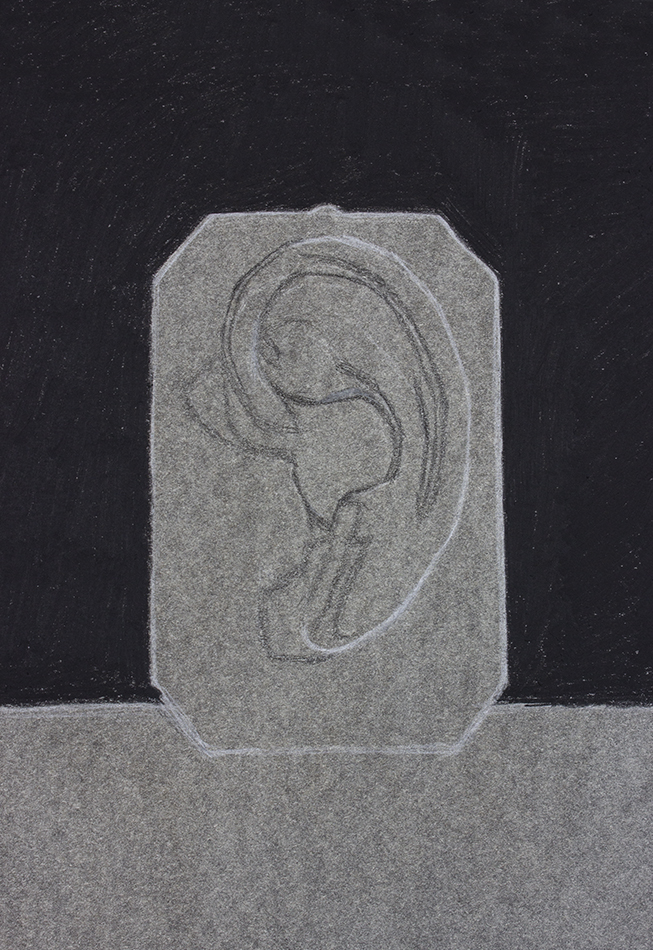
If I know that I am going to add a background to my drawing, I ever work 'from back to front', meaning from the background to the foreground, especially if information technology is one of the darkest values in the scene, every bit it is here! Why? A value in isolation looks different adjacent to another value. Placing a darker value next to a lite value makes the light value look even lighter!
This means that if I look to add my groundwork until after I draw the ear cast, it's likely that the ear will be far too low-cal, because calculation the dark background volition only crusade information technology to appear lighter.
Instead, my kickoff goal when beginning to shade is to establish my basic value relationships: where are the nighttime values, the light values, and the center values in my scene?
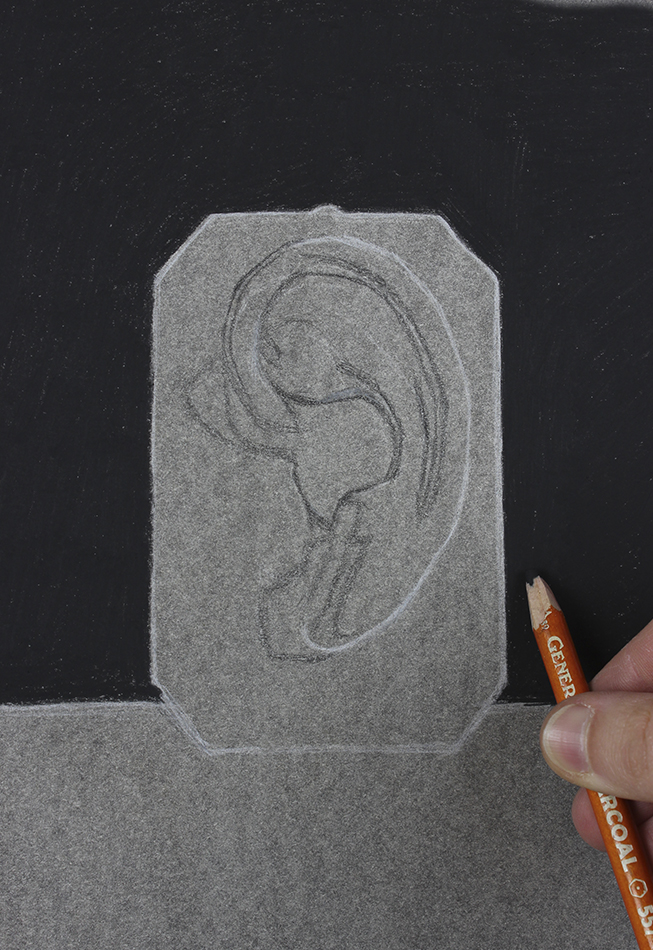
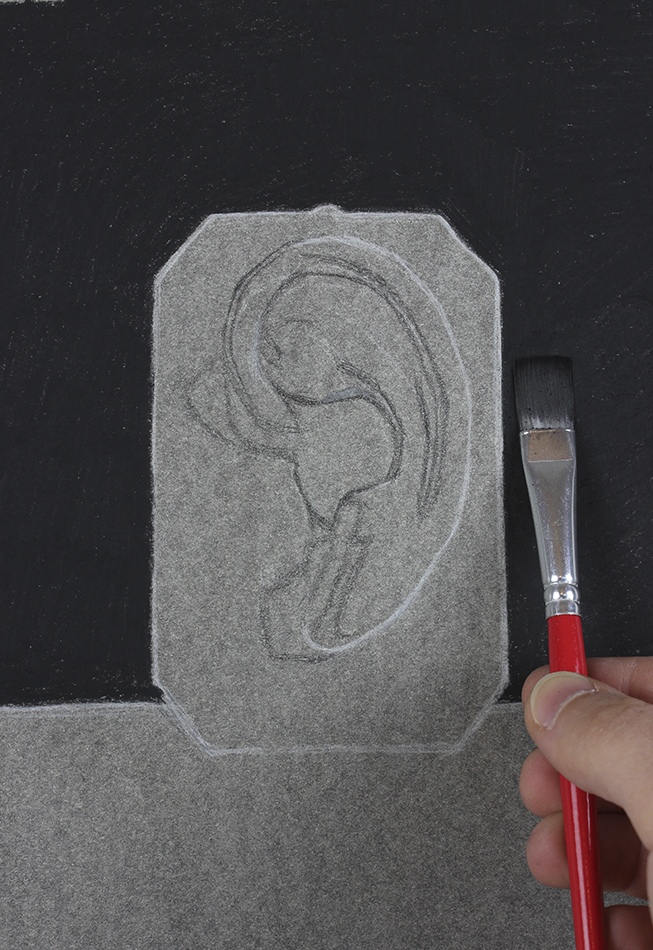
I draw the background in three 'passes' - I utilize a 6B charcoal pencil to densely describe it kickoff, so I smooth information technology out with a paintbrush. Using a paintbrush to smooth out charcoal always lightens its value, and so ...

... I then go over the background one more fourth dimension with my 6B charcoal pencil.
Creating a Black and White Charcoal Drawing:
Analyzing the Value Structure of the Subject
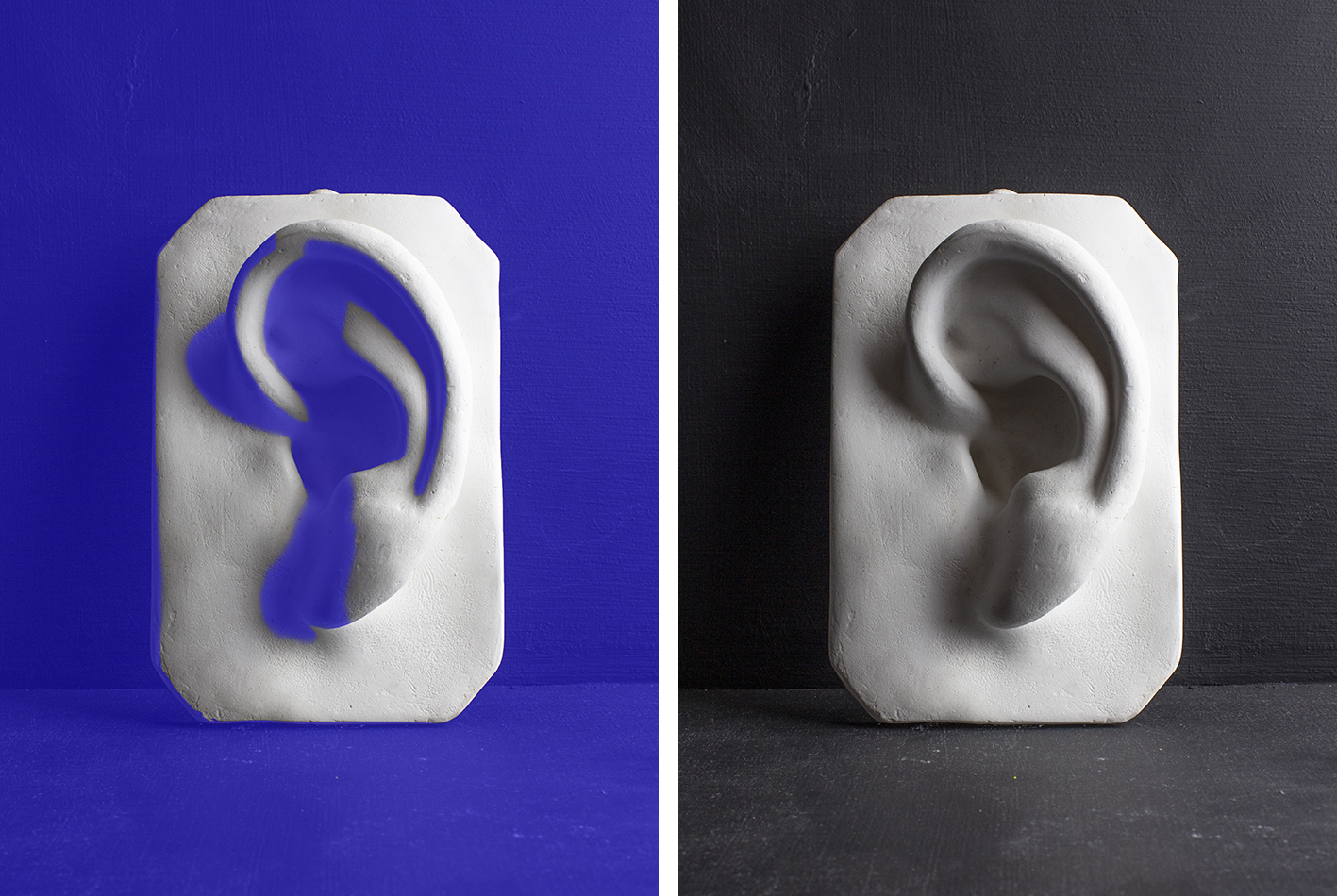
Dark Values
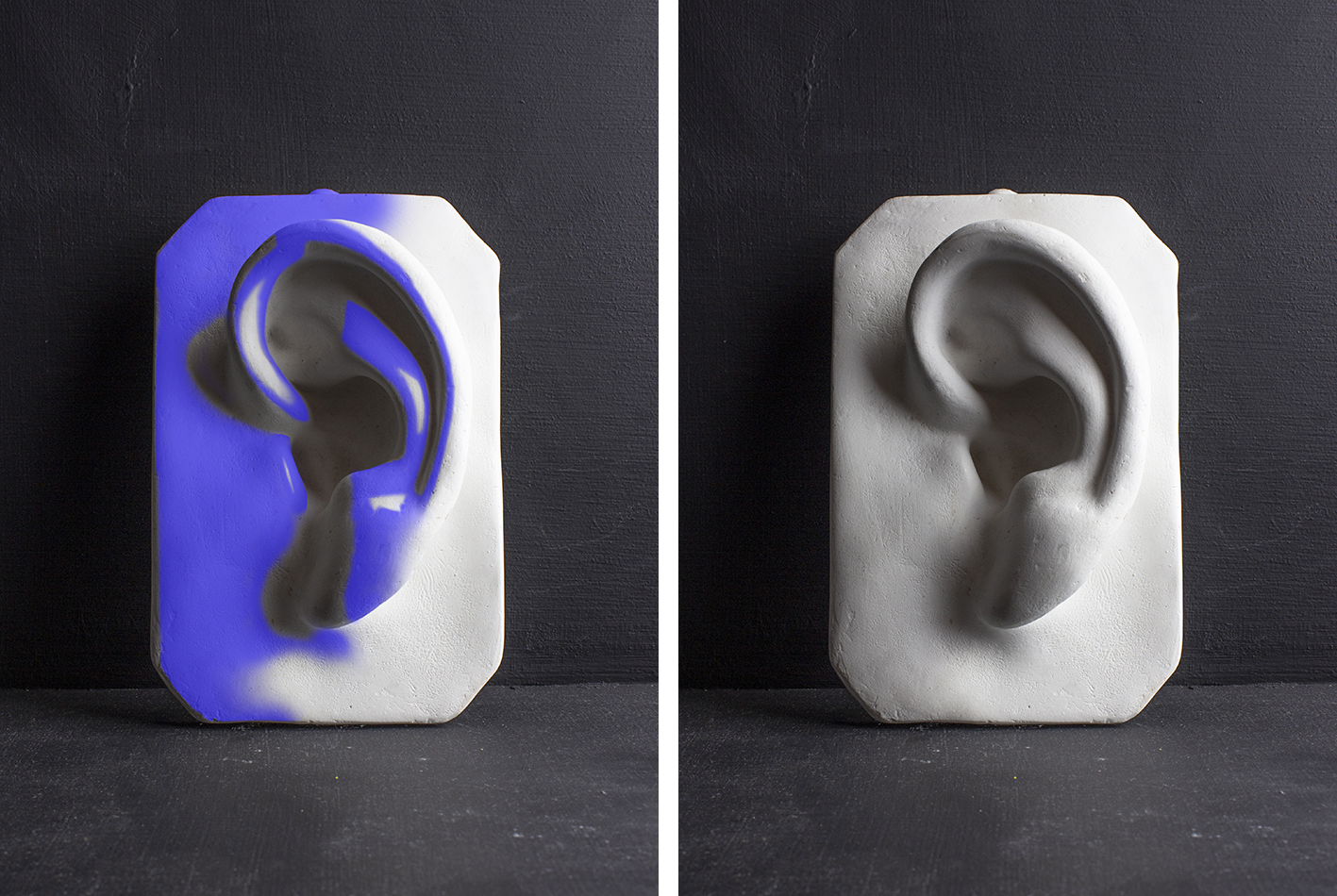
Half-Tone or Eye Values
Light Values
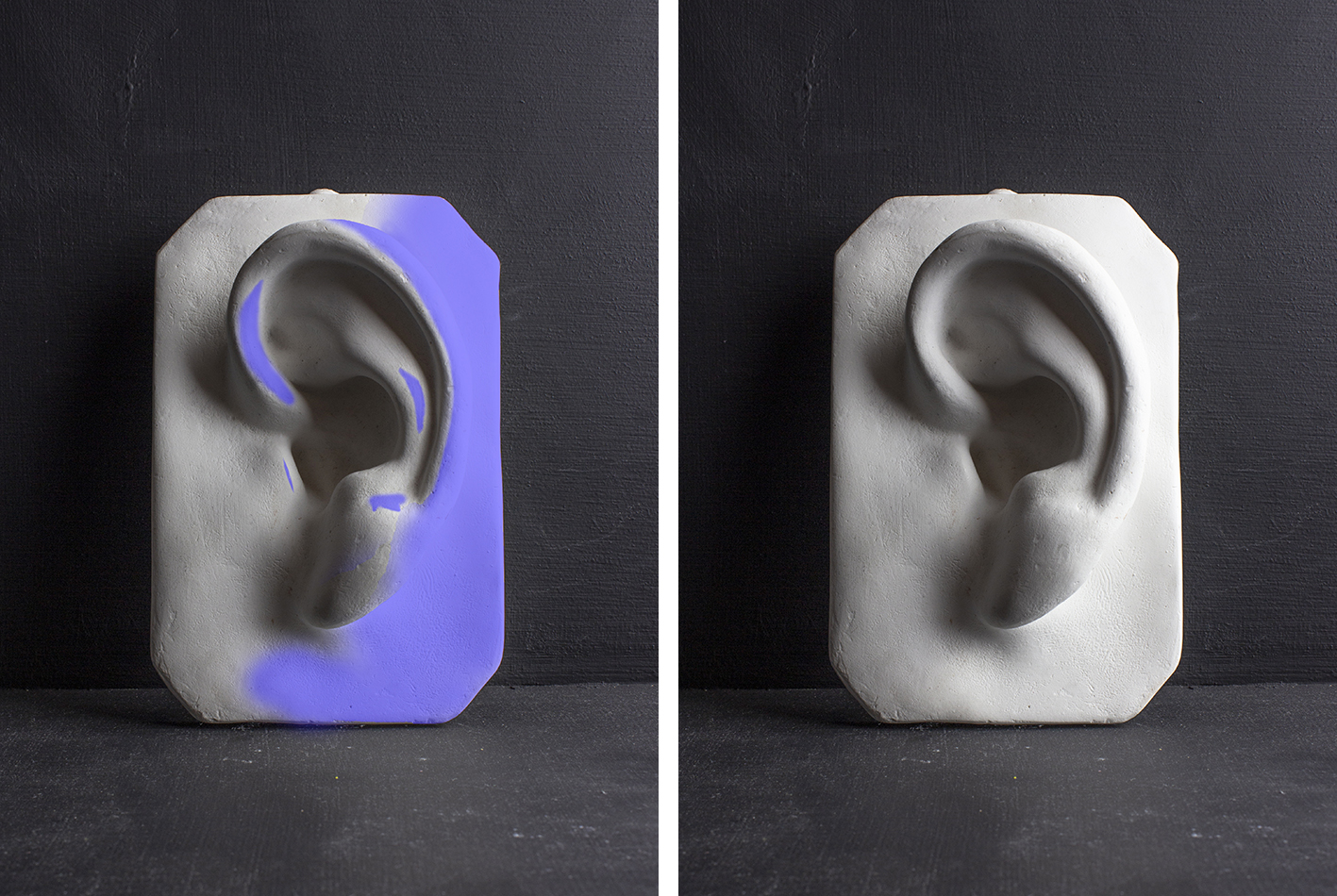
To a higher place is the my first goal: to determine where the calorie-free, nighttime, and center values are on the discipline, and to mass in these iii simplified groups of value on my drawing.
How do I determine what is low-cal, half-tone, or dark? One of the most constructive strategies for simplifying values is to squint: literally to half-close your eyes, and notice which areas merge together.
For example, looking at the Half-Tones Diagram above, y'all may exist thinking that there are several values in the area to the left of the ear, some of which might be lite values. Certain - with your optics open, yep. However, squint way downward and look again. Notice how light the right one-half of the plaque that the ear is on appears, and how the half-tones on the left side merge together.
The left side will have to be half-tone and then that the right side can perceived equally beingness lighter. Comparison is another effective strategy for determining how low-cal or dark to brand a value!
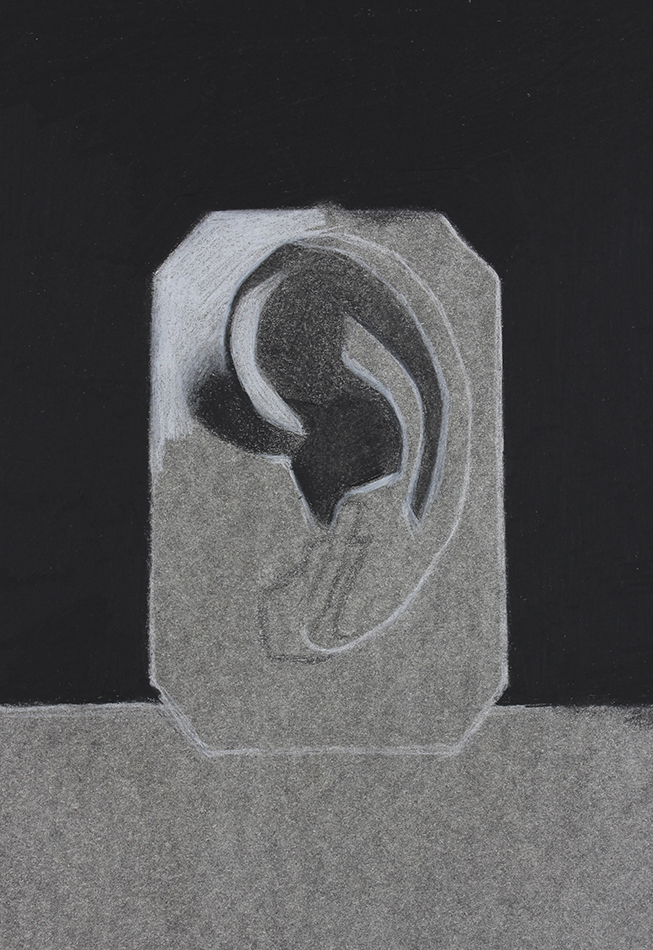
I begin massing in the light and dark values, and will leave the one-half-tones for later. I'm non worried well-nigh smoothen rendering at this betoken, because I will be adjusting the values for some time.
Massing in these light and dark shapes also greatly helps me to judge the accuracy of my proportions. Even though I am working with value, which is ofttimes thought of as the stage after the cake in, I am yet very consciously looking at the proportions of my subject and adjusting them as needed.
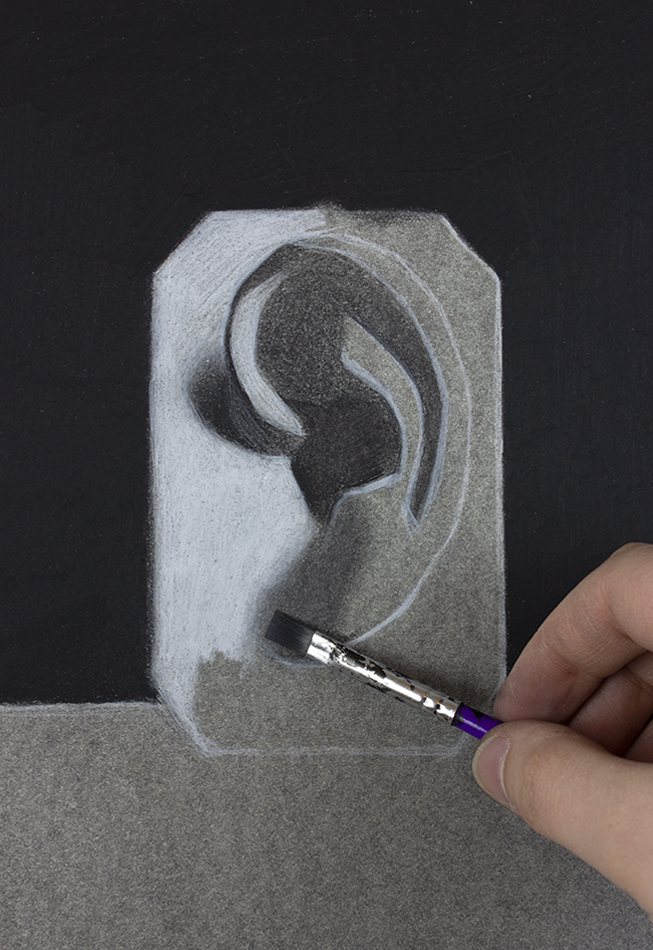
Though I am not yet at the phase where I am focusing on the quality of the edges throughout my drawing, I utilise a paintbrush to create a softer gradation where the softest edges will eventually be.
Note that you can freely layer white charcoal on top of regular charcoal, or vice versa. Working additively (only adding values) instead of subtractively (by taking abroad value with an eraser) may accept some getting used to, but one time you do, information technology may give you a new sense of freedom.
For some students, correcting a mark by cartoon overtop of it rather than erasing feels less like a mistake, which is excellent, considering you shouldn't be worried nigh making mistakes! Making a 'mistake' merely means that you are seeing more sensitively than y'all were before. That is what enabled you to observe the difference, and is a positive sign that you are evolving one of your most important drawing skills: the ability to 'meet'.
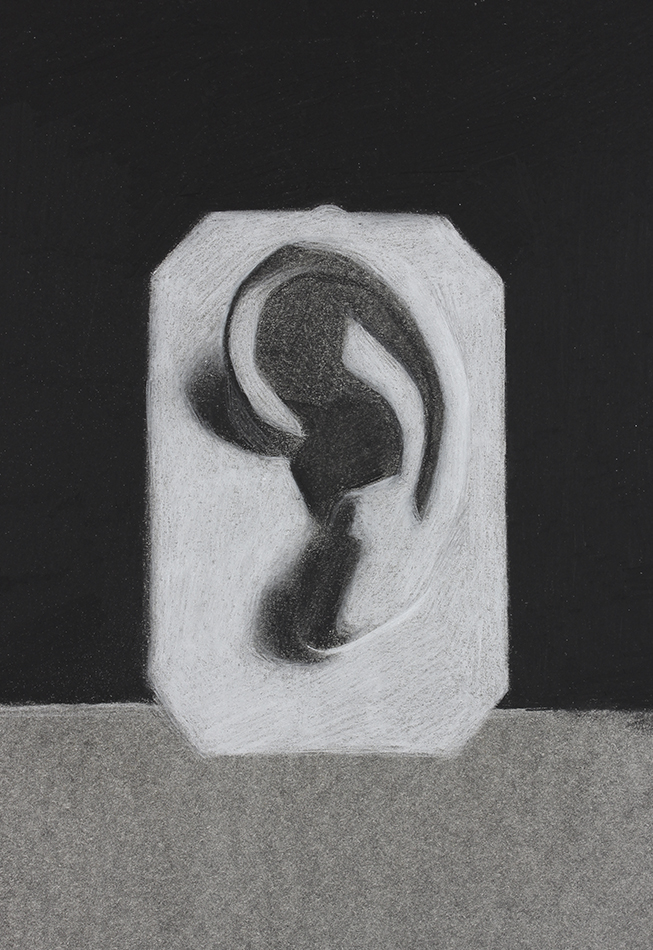
I take my dark and light values mapped out on my drawing, and am feeling much more confident in the overall proportions. Before I can motion on to the one-half-tones in my drawing, I need to mass in the bottom portion of the groundwork.
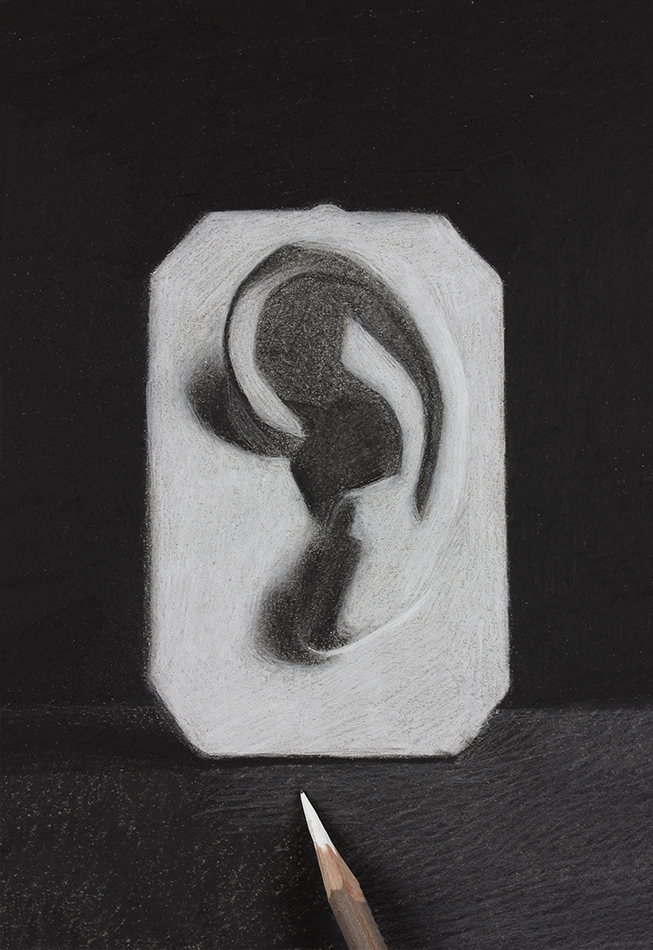
I draw in the lesser portion of the background in 2 stages. I brainstorm by cartoon in a slightly darker value than the groundwork really is. This allows me to then layer white charcoal on top, imbuing this expanse with the bluish hue that white charcoal provides. This has the effect of unifying the prototype.
Don't forget to include the shadow cast by the ear onto the surface that it rests on, which is 1 of the darkest values in the scene, similar in value to the acme portion of the background.
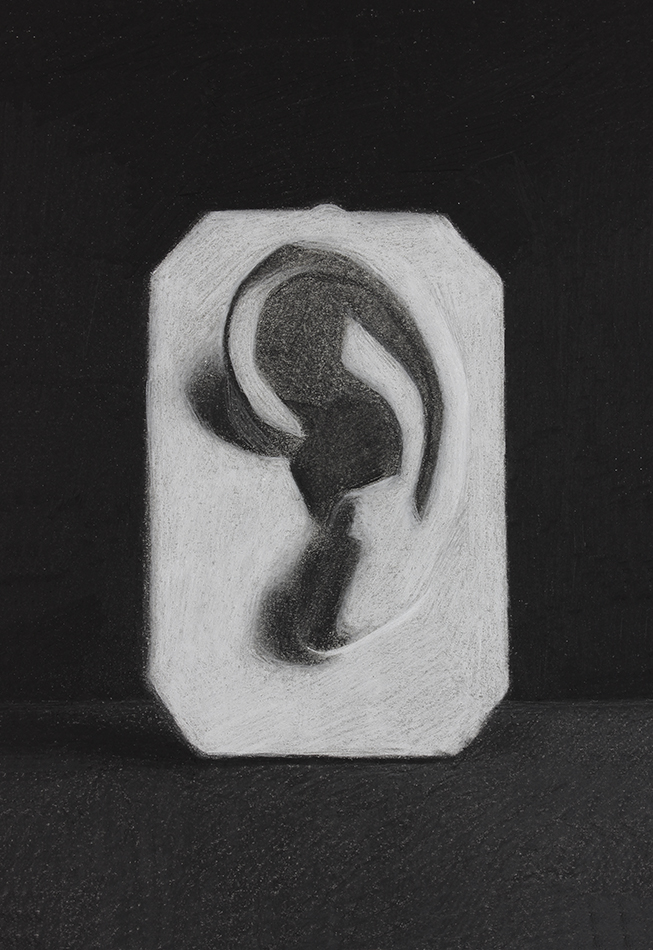
I at present have a solid foundation for my drawing. I take established the large and small proportions, the low-cal and shadow shapes, and I take started pulling out a few dark accents, though by and large to bank check my proportions in the shadow areas.
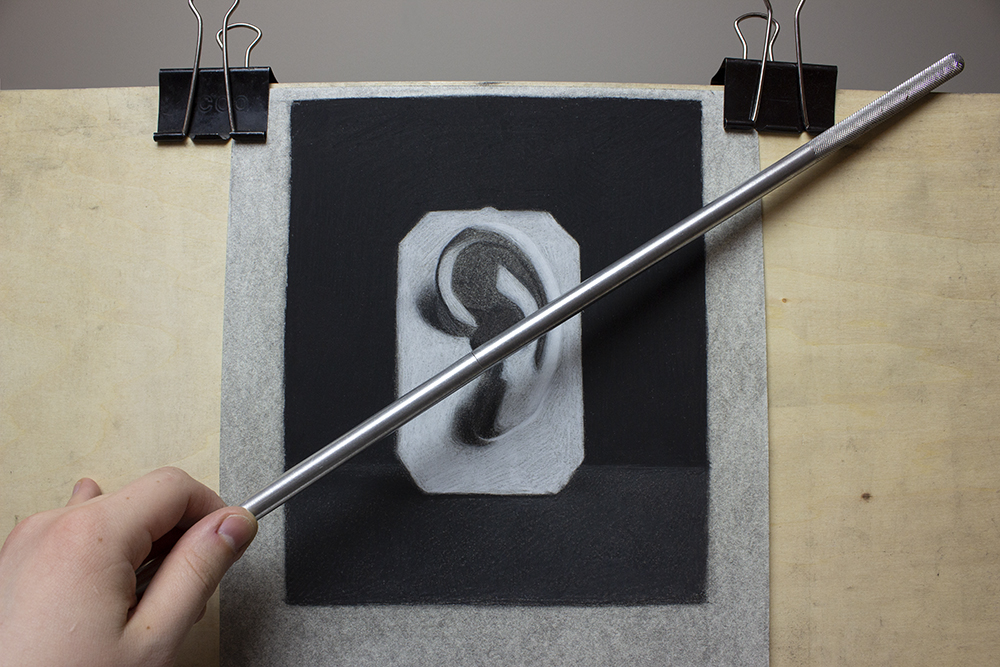
Earlier we move on to the adjacent footstep, I desire to give you an idea of my drawing setup. It'due south nothing fancy - my drawing is comfortably attached to my drawing lath with bulldog clips (very convenient for taking off my drawing repeatedly to take progress photos).
When you lot compare the edges of my toned paper to the fatigued areas where I have used white charcoal, you can see how much cooler and bluer the areas with white charcoal are.
Note: An important point is that I am using a Mahl stick to proceed my hand from resting on my cartoon. I am right handed, and so I concur the Mahl stick with my left hand, and rest it against the top of my drawing board on the right. Watch my video on how to agree and command a drawing pencil for an case of this.
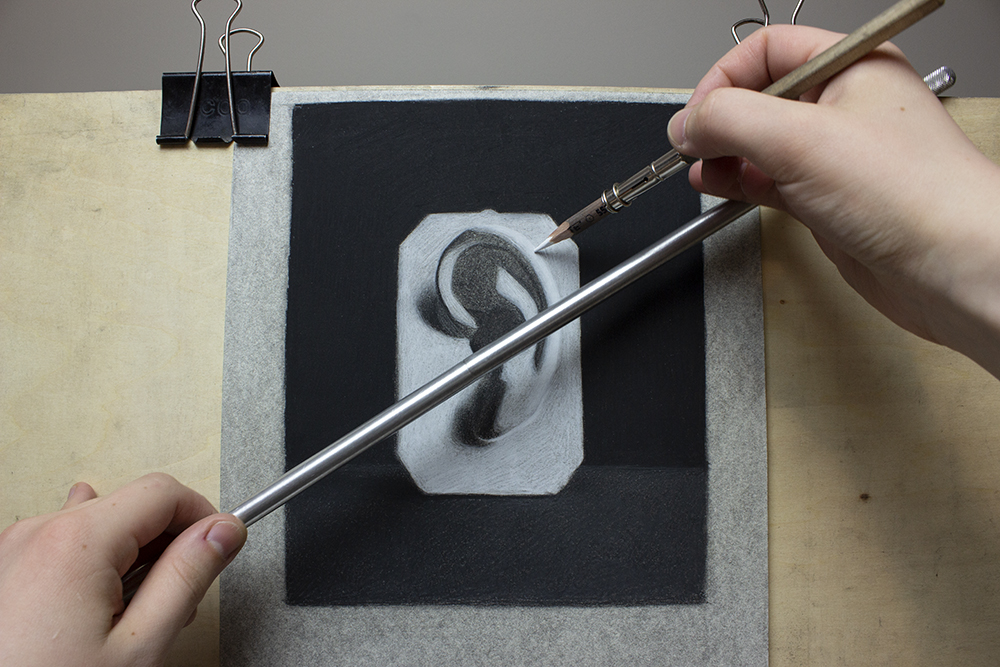
My drawing hand tin can and so remainder on the Mahl stick, giving it stability and allowing me to reach all areas of my cartoon comfortably, without smudging information technology.
If you don't have a Mahl stick, a sturdy ruler or curtain rod will work just besides!
Darkest Nighttime Values
Lightest Lite Values
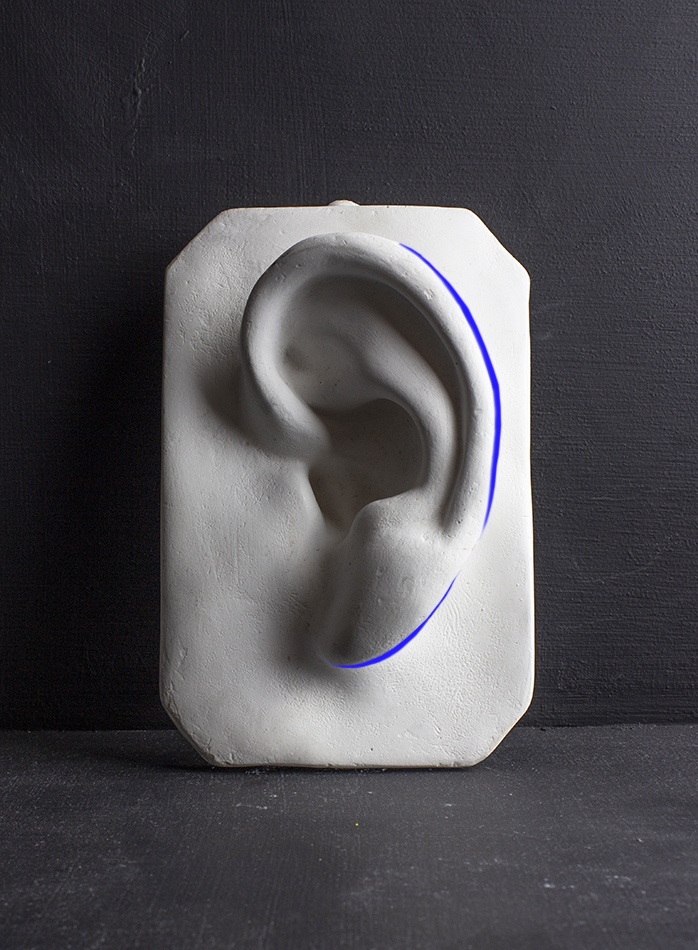
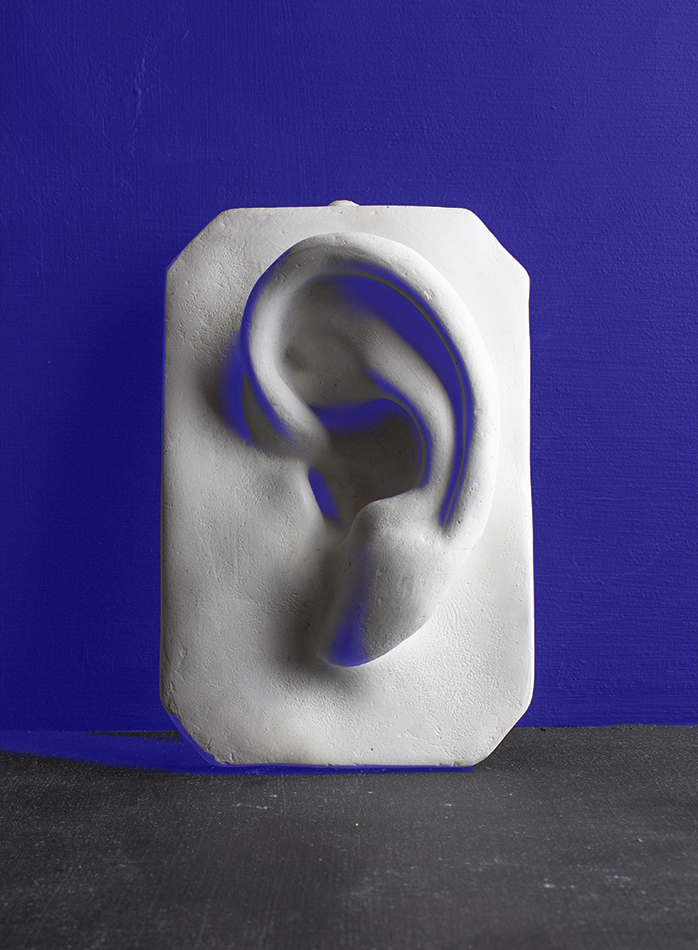
My side by side goal is to found the 'darkest night' values and the 'lightest light' values in the scene. I'm looking for my two value extremes in the paradigm. Squint at the photograph reference (downloadable at the bottom of this page) and enquire yourself:
Where are the absolute darkest values in the scene? Before, we broke down the image into lite, midtone and dark. Within those nighttime values will be certain accents that are the darkest in the scene, and areas that are slightly lighter but however fall into the 'dark values' category.
Where are the accented lightest values in the scene?
This step is not exclusive to black and white charcoal drawing! Information technology is an essential step to all successful value drawing.
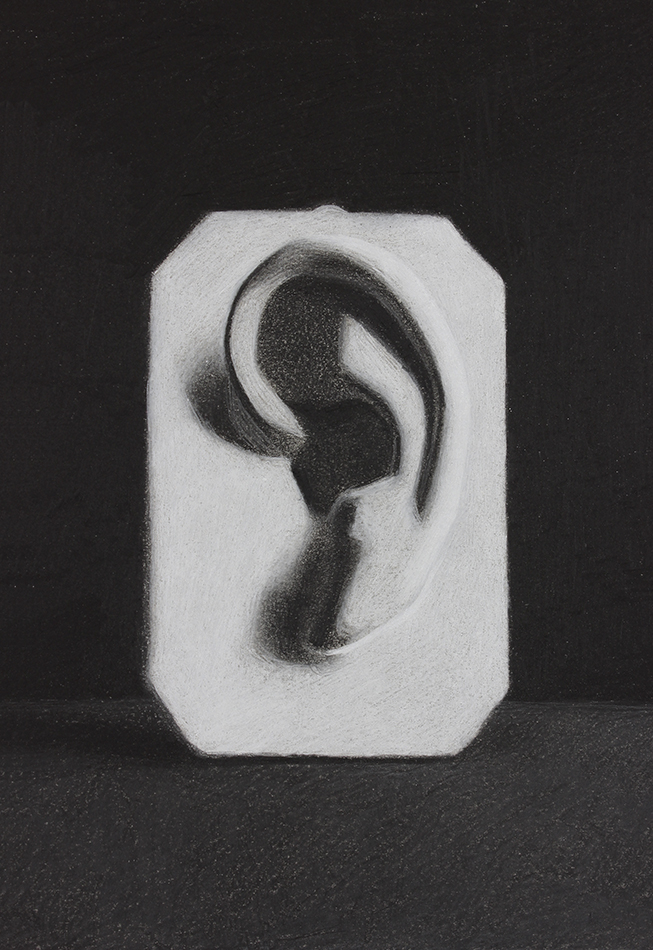
Here I accept established the 'darkest dark' values and 'lightest light' values that were indicated in the diagrams above. Nosotros always desire to establish these value extremes early on in the drawing, and then that nosotros accept those two variables to compare the residuum of our values to.
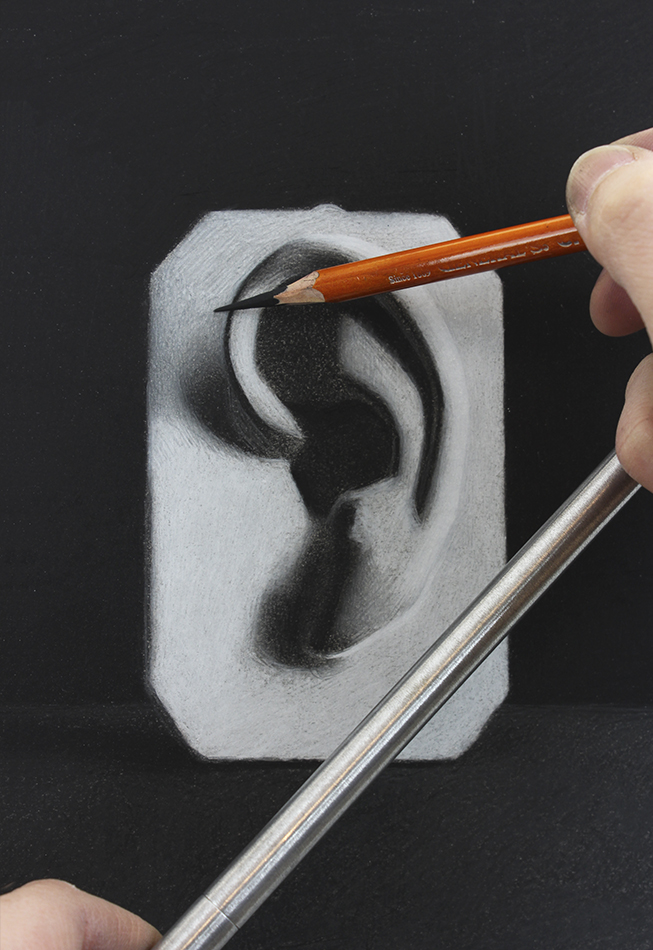
Only now that I accept established the value extremes in the scene practice I start drawing the half-tone values.
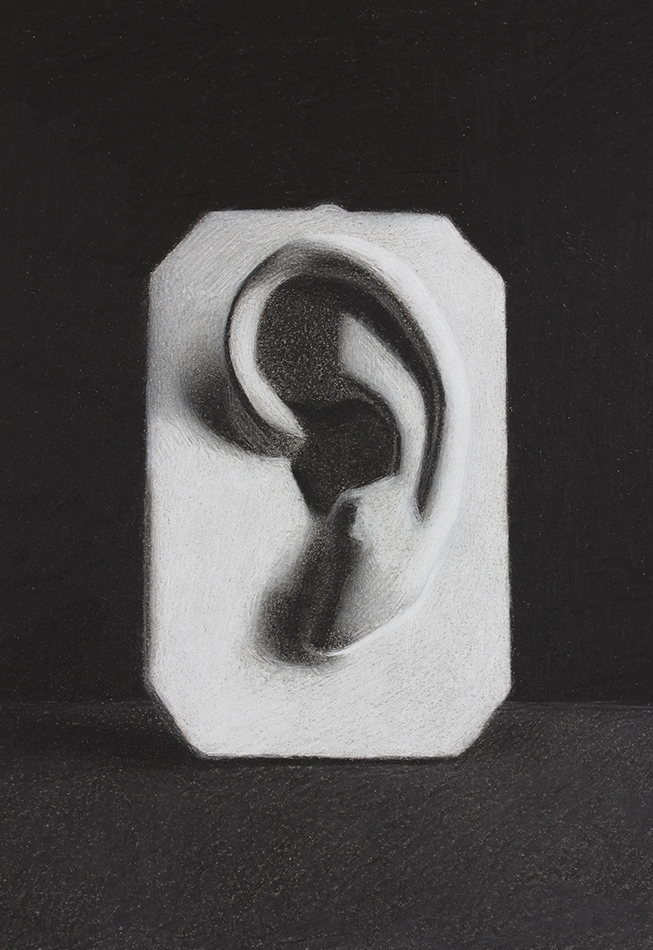
I begin cartoon in half-tones where the softest edges are in the scene - areas with tiresome gradations, such as the earlobe, and the summit left portion of the plaque, where the shadow cast by the ear slowly turns into a middle value.
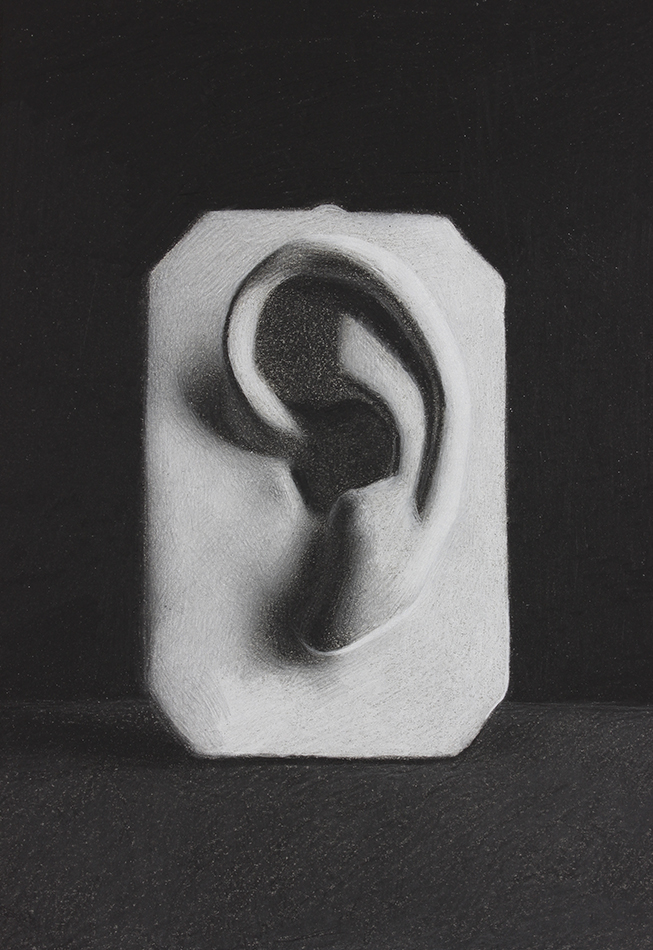
As we saw in the Half-Tones Diagram earlier in this article, the unabridged left side of the plaque falls into the 'heart value family'. This is especially evident when we squint and compare the left side of the plaque to the right side. Hither I am standing to tone downwardly the left side of the plaque, while beginning to model some of the smaller indentations and protrusions through subtle shifts in value.
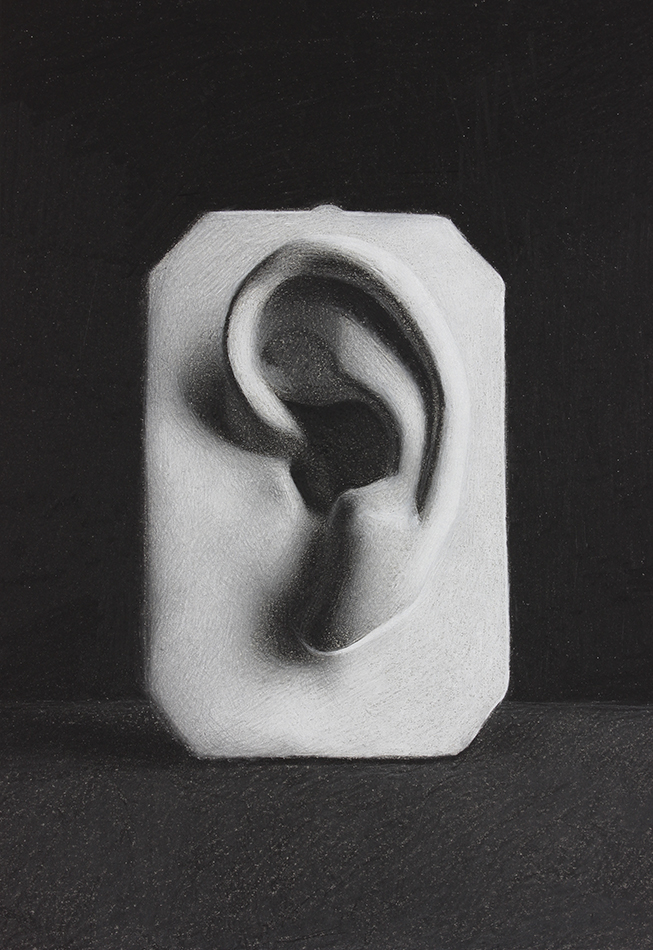
I am starting to develop the forms within the shadow expanse inside the ear. These demand to remain dark enough to read as existence 'dark', not 'half-tone' (if I squint, they should still merge together into 1 dark mass).
Smoothing and Finishing
the Blackness and White Charcoal Drawing
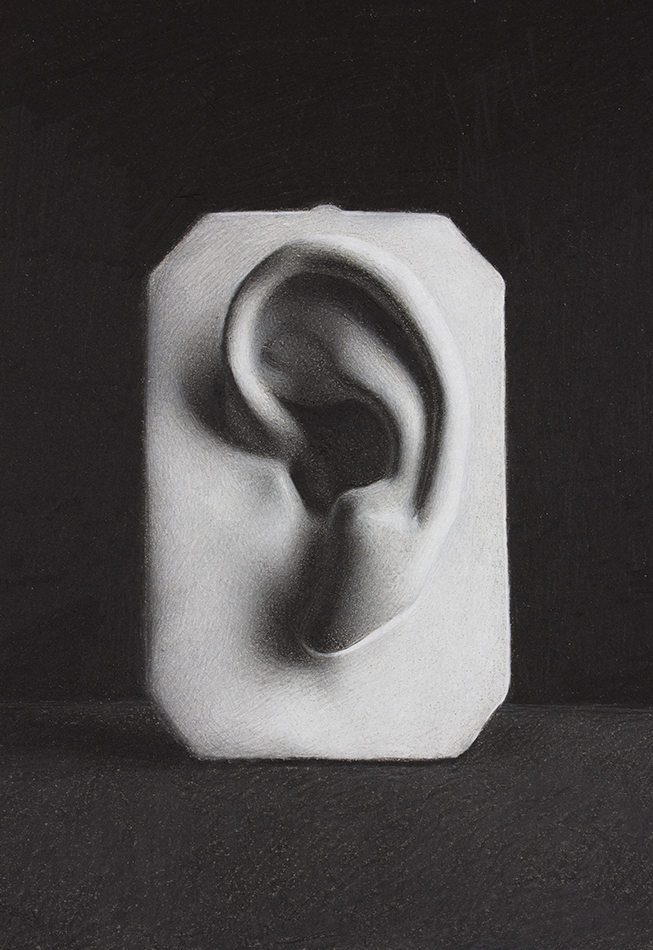
At this point I am smoothing and refining my black and white charcoal cartoon. I smoothen out the inconsistencies in value by filling in the value gaps left between pencil marks.
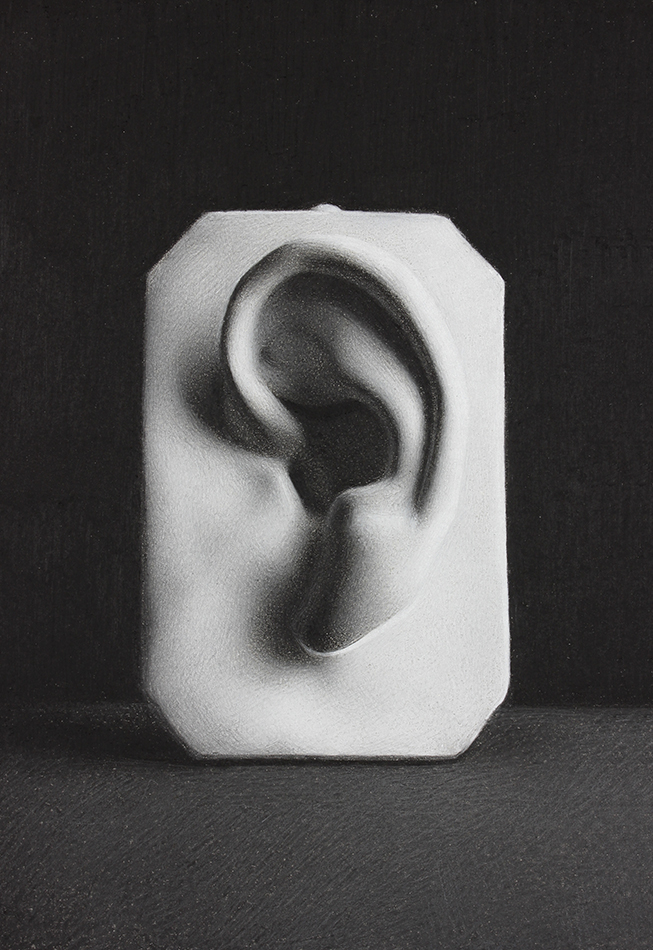
The last element that I will work on is the surface on which the ear bandage rests. Currently it has little variation, and is not withal finished to the same caste as the ear. It doesn't need to be every bit detailed or nuanced as the ear considering I don't need or want to attract the eye to this bottom third of the cartoon. However, in society for it to not expect out of place, I will smooth out areas past filling in the tiny gaps in value between the pencil marks, and add some slight variety to the surface.
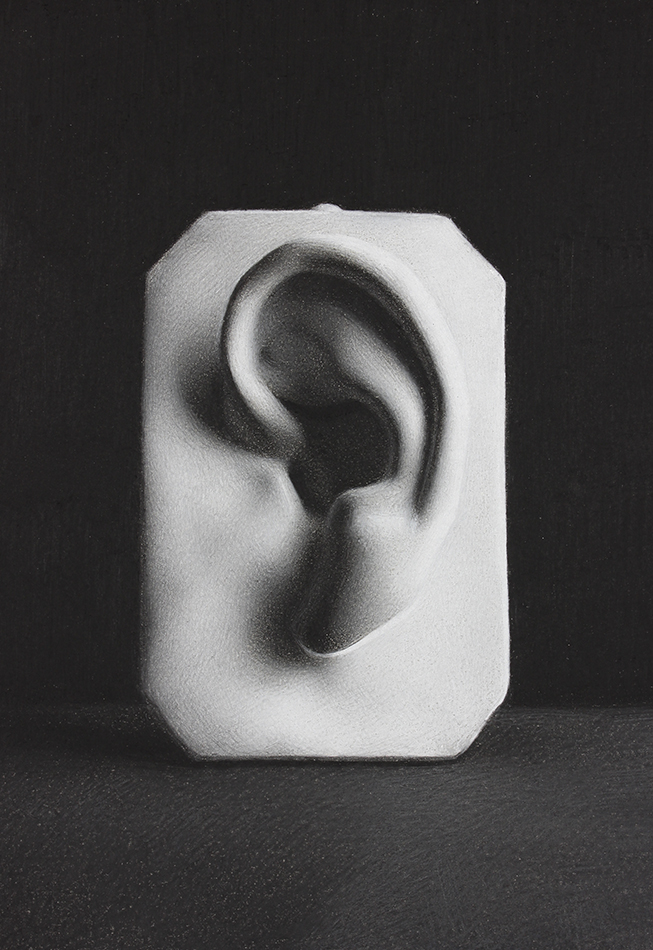
I have added some slight variations to the background to conclude my drawing!
I hope yous try this blended black and white charcoal drawing technique! You can download the reference photo of the ear cast I have been drawing from beneath, and first experimenting with the technique that way. Or, offset with a simpler field of study matter - a sphere, for example!
(There is also a downloadable infographic of this step by step tutorial available in the Gratis Members-Only Drawing Resource Library! Enter your email below if you're non a member yet!)
Requite it a effort and let me know what you think. If y'all accept any questions pertaining to this composite black and white charcoal cartoon technique, please annotate below, or email me at marina@thedrawingsource.com
Happy Drawing!
F R Due east E D O W Northward Fifty O A D
Acquire to use this black and white charcoal drawing technique past downloading ...
- A reference photo of the ear cast I'thou drawing from
- An infographic of this step by stride tutorial
- Plus, receive a weekly newsletter and access the complimentary Members-Only Drawing Resource Library!
Enjoyed this page? Please share it!
Share buttons and pinnable image below:
If yous enjoyed this page on blended blackness and white charcoal drawing, you may too enjoy ...
Related Pages
How to Describe Drinking glass Using White Charcoal on Blackness Newspaper
3 Ways to Employ White Charcoal Pencils
How to Make Toned Paper
Render to Drawing Tutorials from How to Create a Blended Blackness and White Charcoal Drawing

Source: https://www.thedrawingsource.com/black-and-white-charcoal-drawing.html
Posted by: patrickkilve1982.blogspot.com
0 Response to "How Do Artists Create Different Gradations Of Black When They Draw With Charcoal?"
Post a Comment